
Under
the slab
Almost every house in {{MAIN_AREA}} sits on a concrete slab, and in a good many of them the water supply runs inside it or beneath it, where nobody can see a pipe until it has already failed.
A slab leak is not usually a burst. It is a pinhole that has been running quietly for weeks into ground you cannot inspect, under a floor you cannot lift.
What is actually down there
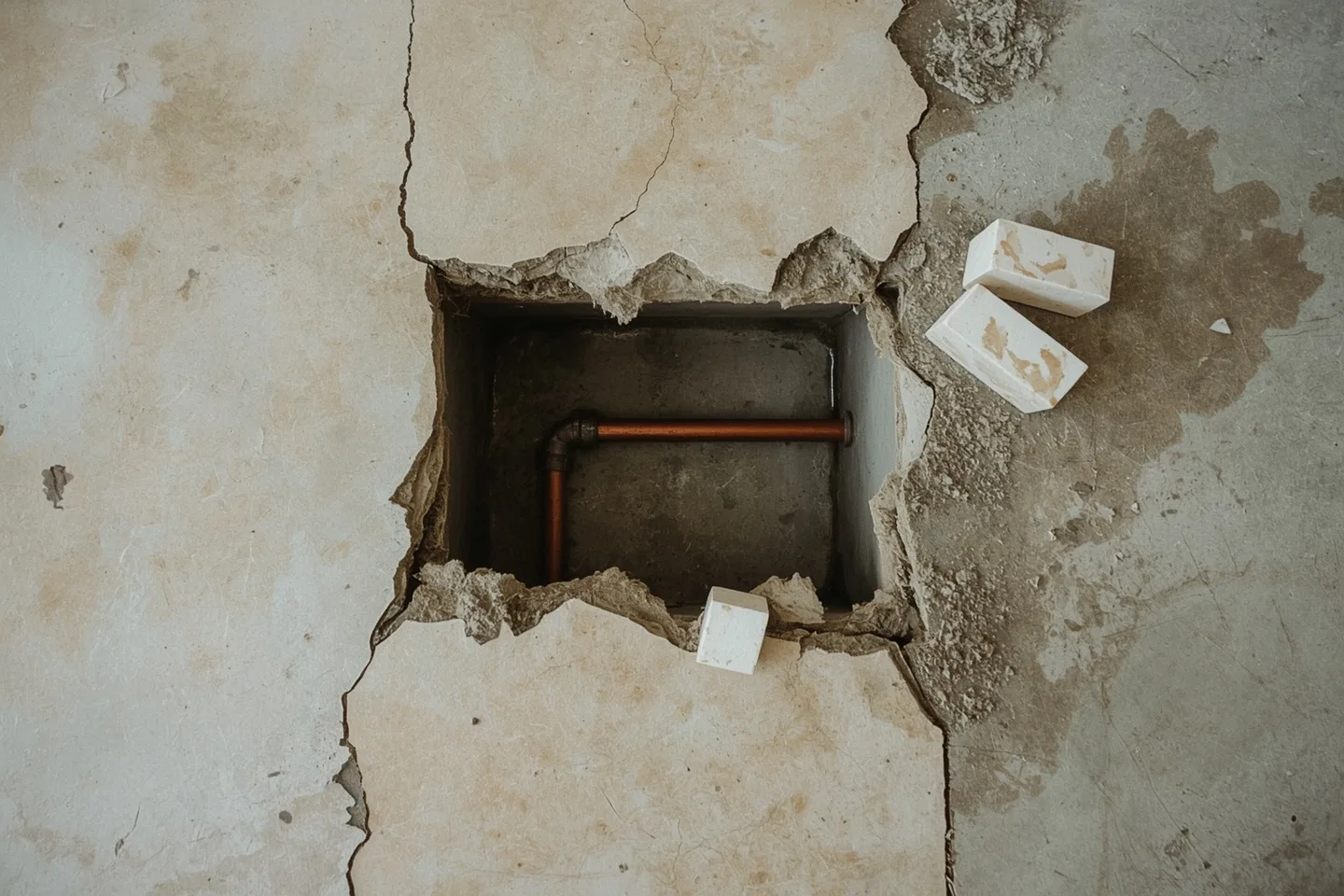
On a slab on grade house the concrete is poured over prepared ground and the plumbing is placed before the pour. Drain lines go under the slab because they have to fall toward the sewer. Supply lines, in many houses built here, were run the same way: soft copper laid in the sand bed or embedded in the concrete, coming up through the slab at each fixture.
That worked for decades. What it removes is any possibility of inspection. Every other pipe in a building can be looked at or opened up if something seems wrong. A line in the slab announces itself only through symptoms, and by the time a symptom is obvious the water has been going into the sub base for some time.
What attacks the copper
Copper does not wear out on a schedule. It fails where something is attacking it, and this valley supplies several things at once.
Why the lines fail
here in particular
- 01
Hard water and scale
Water here is hard, and dissolved mineral comes out of it as scale inside the pipe. Scale does not form evenly. It builds in ridges that disturb the flow, and turbulent water past a rough spot erodes the copper just downstream. That is why pinholes appear in clusters along one run rather than randomly through the house.
- 02
Soil chemistry
Copper in direct contact with certain soils corrodes from the outside in. Conditions vary across the valley, and a line laid in fill from one place behaves differently from an identical line a mile away.
- 03
Abrasion in the pour
A line crossing a piece of aggregate, or pinched during construction, has a small area of contact that never moves. Every time hot water runs the copper expands against that point and slides back as it cools. Over thirty years of daily cycles that is a hole, and the hot line is where it happens first.
- 04
Pressure and heat
Hot lines run under more stress and see the temperature swing as well. When a house sits closed through a valley summer, the system runs hotter for months with nobody drawing from it.
How people actually notice
There is rarely a dramatic moment. Each sign has an innocent explanation, which is why they get lived with.
- 01
A warm patch on the floor
The clearest single sign, and it means the hot line. Walk the tile in bare feet early, before the sun has been on the floor. A patch consistently warmer than the tile around it, with no appliance above it, is hot water running under the slab.
- 02
The meter moves with everything off
The most useful test a homeowner owns, and the one that turns a suspicion into a fact.
- 03
Running water with nothing running
A faint hiss or trickle, clearest at night or with an ear to the floor, matching no fixture, no irrigation timer and no pool equipment.
- 04
Water charges that climbed and stayed climbed
Not one high month, which usually means landscaping. A step up that persists across several months with no change in the household.
- 05
Damp at the edge of a room with no source above it
A baseboard that swells, grout that stays dark in one area, a damp carpet edge, a floor tile that sounds hollow when its neighbours do not. Water under a slab comes up at the perimeter and the joints, because that is where the concrete lets it.
How to confirm it before
anybody opens anything
In order, and none of it involves opening anything.
- 01
Shut off everything that uses water
Every tap, the ice maker, the irrigation controller, the pool fill valve, the softener, the evaporative cooler if it is the season. The point is a house that should be drawing nothing at all.
- 02
Read the meter, wait, read it again
Find the meter on the street side of the property and note the reading, including the leak indicator triangle if yours has one. Come back in an hour. Any movement means water is leaving the system between the meter and the fixtures.
- 03
Separate the house from the yard
If there is a shut off valve at the building, close it and repeat the test. If the meter stops, the loss is outside in the irrigation or the service line. If it keeps moving, it is between the meter and the valve. If closing it changes nothing, the loss is inside the house.
- 04
Isolate the hot side
Close the cold inlet valve on the water heater and test again. A leak that stops when the heater is isolated is on the hot line, which is the most common case and useful to whoever locates it.
- 05
Walk the floor and map what you find
Warm spots, damp perimeter, hollow sounding tile. Mark and photograph them. A rough map of the symptoms shortens the location work.
- 06
Get it located, not guessed
Leak location is done with acoustic equipment, tracer gas or thermal imaging, by somebody who does it regularly. Everything afterwards is decided by how precisely the leak was found. Nobody should be cutting concrete on a hunch.
The three ways it gets repaired
There is no single correct answer. The honest version of this conversation is about what the house is and how much life the rest of the plumbing has in it.
Open the slab at the leak
The floor covering comes up, the concrete is cut out over the leak, the damaged section is repaired, and the slab and finish are put back. It addresses one hole. It suits an accessible leak in a house whose plumbing is otherwise sound, or a floor that was going to be replaced anyway. Its weakness is that it does nothing about the rest of the same pipe in the same conditions.
Reroute the line overhead
The failed run is abandoned in place and a new line goes up a wall, through the attic and back down to the fixtures it serves. No slab is broken, the pipe ends up somewhere that can be inspected in future, and the patching is drywall rather than concrete. The attic run needs proper insulation, because an uninsulated line in a valley attic in July is its own problem.
Repipe the house
Everything in the slab is abandoned and the whole supply system is replaced overhead. This is the answer when the leak is the second or third one, when this one is somewhere awkward, or when a plumber has seen the pipe that came out and can tell you what the rest of it looks like.
Policies commonly cover the damage the water caused, including the cost of access, while treating the failed pipe itself as a maintenance item. Raise that with the adjuster early rather than at the end.
What decides between them
- 01
Leak history
How many leaks the house has had.
- 02
Where it sits
Where this one is.
- 03
The floor above it
What the floor covering is.
- 04
The pipe that came out
What condition the removed pipe is in.
- 05
How long you are staying
How long the household intends to stay.
- 06
What the carrier will do
What the carrier will participate in.
What a post-tension
slab changes
A post-tension slab contains steel tendons held under very high tension. Cutting one is dangerous and can compromise the slab. Newer construction across the master planned communities is frequently post-tension, and the tendons must be located and mapped before any concrete is cut, by somebody equipped to do it.
In a post-tension pour, steel cables in plastic sheathing are laid through the slab and tensioned after the concrete cures, which lets a thinner slab span ground that moves. Much of the newer housing in the Goodyear, Buckeye and Verrado subdivisions is built this way, and there is usually a plate at the garage or the panel saying so.
The consequences are straightforward. Nothing gets cut until the tendons have been located and the cut path marked, which is specialist work and means the people opening the floor are not necessarily the people who would open a conventional slab. And it shifts the repair decision, because when opening the floor carries that constraint, rerouting overhead becomes the straightforward option more often than it otherwise would.
If you do not know which kind of slab your house has, find out on a calm afternoon rather than on the day somebody is standing in the kitchen with a saw.
Read next
-
01
The 48 hour window
Why a slow leak under a floor is the classic way a wall cavity stays wet with nothing showing.
-
02
The first hour after a leak
What to do when a line lets go all at once instead of weeping.
-
03
The house nobody is in
Why a closed summer house is the worst place for a supply line to fail.
-
04
Questions and answers
Twenty questions about claims, drying, mold and what any of it depends on.
If the meter is moving
and nothing in the house
is running, it is worth having
somebody read the floor.
Emergency service across the valley, dispatched 24 hours a day. Independently owned and operated.