
The 48 hour
window
Mold needs moisture, a food source and time. A wall in a house in {{MAIN_AREA}} supplies two of those permanently, which leaves one thing anybody can do anything about.
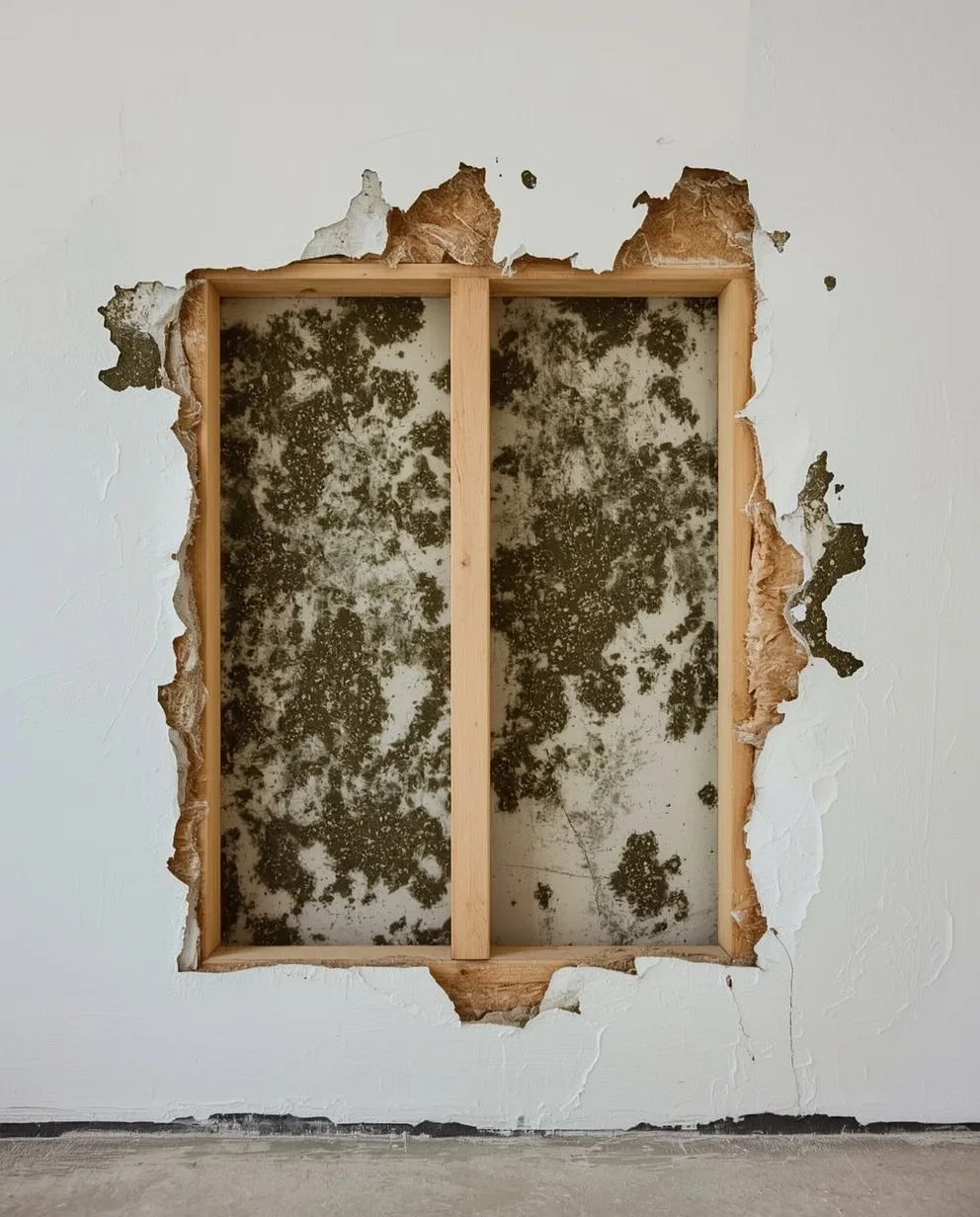
The mold found in this valley is almost always inside an assembly, in a house where every surface in the room felt bone dry to the person living in it.
Two of the three
are already there
Spores are in the air of every building in the world and there is nothing to be done about that. The food source is the paper facing on drywall, plus the dust, the paint binder and the wood behind it, and there is nothing to be done about that either. The third condition is water, and the fourth thing, which is not a condition but a clock, is time.
The usual figure for how long a wet, food bearing material can sit before growth establishes is 24 to 48 hours, and it is not a guarantee in either direction. Warmer material moves faster, and in a closed summer house at 90 degrees inside it is at the short end of that range. Treat 48 hours as the outside of the window rather than a deadline you get to use.
So mold prevention after a water loss reduces to one question, asked about materials rather than about rooms: is this dry yet, and how do you know.
What drying actually means
A room that feels comfortable and a structure that is dry are two different claims, and only one can be checked. Dry standard means a material has been brought back to the moisture content the same material reads in an unaffected part of the same building. It is established with a meter, at marked points, recorded daily, and it is reached or it is not.
The dry climate paradox
Outdoor relative humidity here spends much of the year in single digits, and that is a genuine advantage. Dry air has great capacity to take up moisture, so once air is moving through and across a wet material, this climate dries things quickly.
The catch is the condition attached to it. That advantage exists only where the dry air and the wet material meet. It does nothing for water inside a sealed wall cavity, under a tile floor, beneath a cabinet or behind a shower surround. A wall cavity is a closed box, and the air in it is not the air in the room. It can sit at saturation for weeks while the thermostat reports a comfortable house.
That is why so few of these calls start with a visible problem. Somebody notices a smell in a hallway, a paint bubble, or a floor tile that sounds hollow, and the growth behind it dates from a leak nobody remembers. The room passed every test a person can run by hand, because a person can only test the surface.
Dry standard
- 01
Moisture content
How much water is in a material, read with a pin meter driven into wood or drywall, or through the surface with a non invasive meter.
- 02
Dry goal
The number a wet material has to come back to, taken from unaffected material of the same kind in the same building rather than from a chart.
- 03
Moisture log
The daily record from the same marked points, which shows a carrier that the structure reached dry standard rather than simply asserting it.
- 04
Thermal imaging
A camera that shows temperature difference, which often reveals the shape of a wet area behind a surface. It does not measure moisture, so findings are confirmed with a meter.
Staining is not growth,
and growth is not
always staining
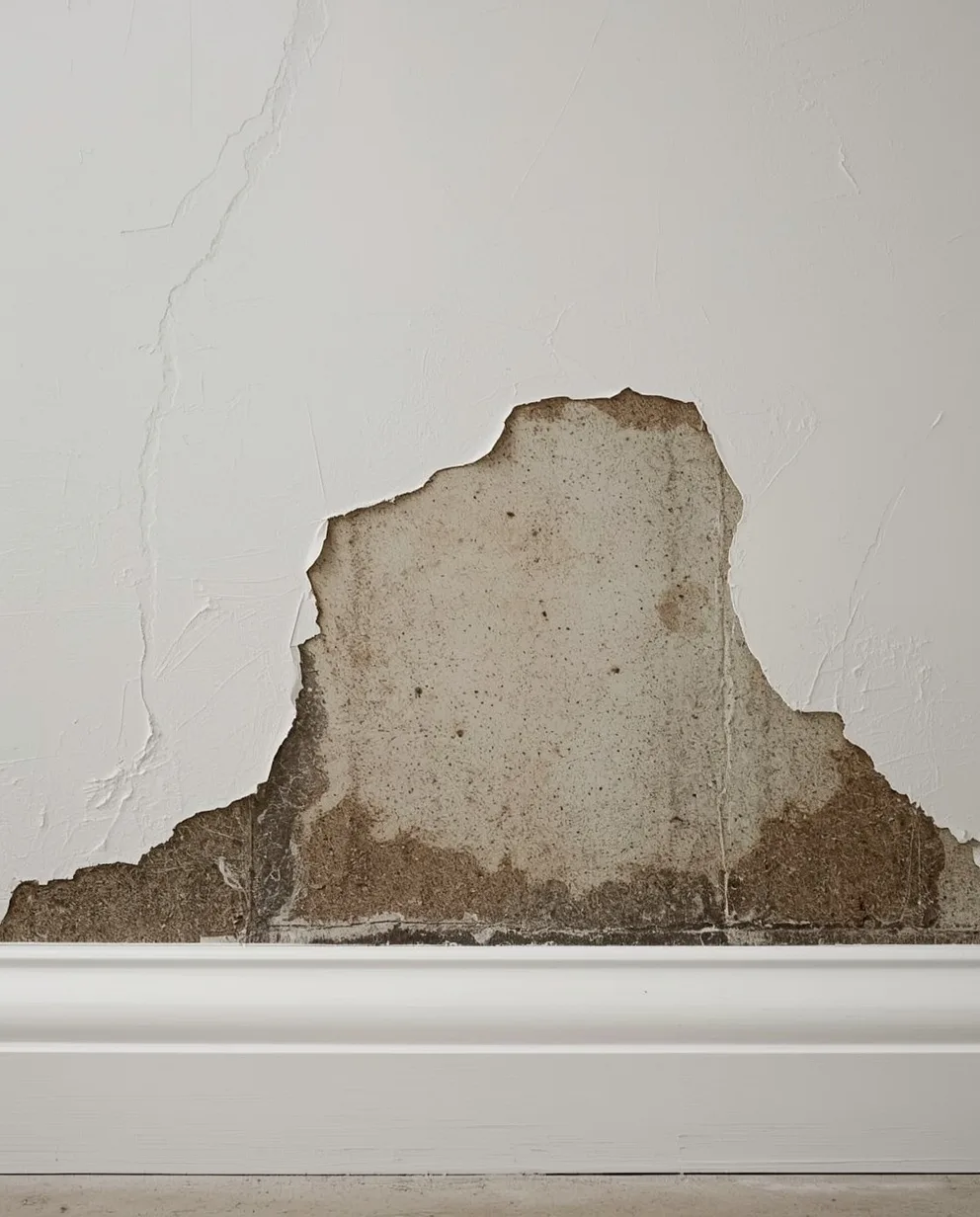
A brown edged tide mark, paint lifting away from the board, a bubbled patch above a baseboard: that is water staining. It records that liquid water was present and moved through the material. It says nothing about whether anything is growing now, and painting over it removes the record without addressing the cause. What it does tell you is where to put a meter.
The reverse is more important. Growth inside a cavity often produces no stain on the finished face at all, because the water arrived from behind. Judging a wall by how it looks from the room is judging the one surface the problem had no reason to reach.
Why the air conditioner is not
a dehumidifier for a wall
Running the air conditioning is the first thing almost everybody does, and it is not useless. A cooling coil condenses moisture out of the air passing over it, so the room air gets drier, and drier room air will pull moisture out of exposed surfaces.
Three things it cannot do.
- 01
No path into a cavity
It cannot move air through a closed cavity, because there is no path.
- 02
Not at the rate needed
It cannot pull water out of material at the rate a dehumidifier and directed air movement are built for.
- 03
It stops long before the framing does
It cycles off when the room reaches temperature, long before the framing has given up anything.
There is a version of this that makes things worse. Closing the house up tight, which is the instinct in July, removes the one thing that was helping: the exchange of interior air with very dry outdoor air. A closed house with a wet cavity in it holds its own moisture, warms up, and meets both conditions that shorten the window. The seasonal houses that sit shut all summer are the clearest case, and there is more in the house nobody is in.
Much of what this branch finds was never a dramatic event. It was a small supply of water, replenished continuously, into a place with no drainage and no airflow. Four local sources account for most of it.
Where the water comes from
when there was never a flood
- 01
A slab leak
A copper supply line under the concrete, weeping rather than bursting, wetting the slab and the bottom plate from underneath. See under the slab.
- 02
A condensate line
An air conditioner removes water from the air all summer and it has to leave the building. When the line blocks with dust bonded by algae, it backs up into the pan and then into whatever is below.
- 03
An evaporative cooler
A machine fed water for months at a time, above the ceiling, where anything it spills drains into the building. See the unit on the roof.
- 04
A roof leak that only runs in a storm
Underlayment ages fast under concrete tile in this heat, and a defect that only passes water in a driving rain wets a ceiling cavity a few times a year. See when the tiles move.
What you can check yourself,
and where to stop
Do not scrub, spray, sand or cut into visible growth to see how far it goes. Disturbing a colony releases spores into the air and turns a contained problem into a distributed one.
Photograph it, close the door, and have it assessed before anything touches it.
- 01
Look where water would collect, not where it entered
The bottom of the wall, the toe kick under the sink cabinet, the back corner of a linen closet, the ceiling edge nearest a rooftop unit. Water goes down and sideways and stops at the first thing that will not let it past.
- 02
Use your nose in a closed room
Shut a suspect room for a few hours, then walk into it. An earthy smell that is there on entry and fades after a minute is a real signal. It is unreliable in one direction only: no smell does not mean nothing is there.
- 03
Read the water meter with everything off
Turn off every fixture and appliance that uses water, then check whether the meter is still creeping. If it is, water is going somewhere in the building, and continuous water is what keeps a cavity wet indefinitely.
- 04
Stop at the surface
Do not open a wall to look. If the cavity has growth in it, cutting it open without containment is the thing that spreads it, and if it does not, you have made a hole for no reason. This is the point to get a meter on it instead of a screwdriver.
- 05
Treat any of these as a reason to have it measured
A stain that has changed size, a floor tile that sounds hollow, a swollen baseboard, a warm patch on the floor, a smell that returns after cleaning, or a water loss nobody metered at the time. None are proof of anything. All are reasons to have somebody read the material rather than the room.
Read next
-
01
The first hour after a leak
What to do while the water is still moving, which decides whether this page ever applies.
-
02
Under the slab
Slab leaks, hard water, and what a post-tension slab changes about the repair.
-
03
The unit on the roof, and the line that drains it
Coolers, condensate lines, and why the damage shows up weeks after it started.
-
04
When the tiles move
Concrete tile roofs, aged underlayment, and the leak that only runs in a storm.
If something has been wet
longer than a day, it is worth
having it measured
rather than watched.
Emergency service across the valley, dispatched 24 hours a day. Independently owned and operated.