
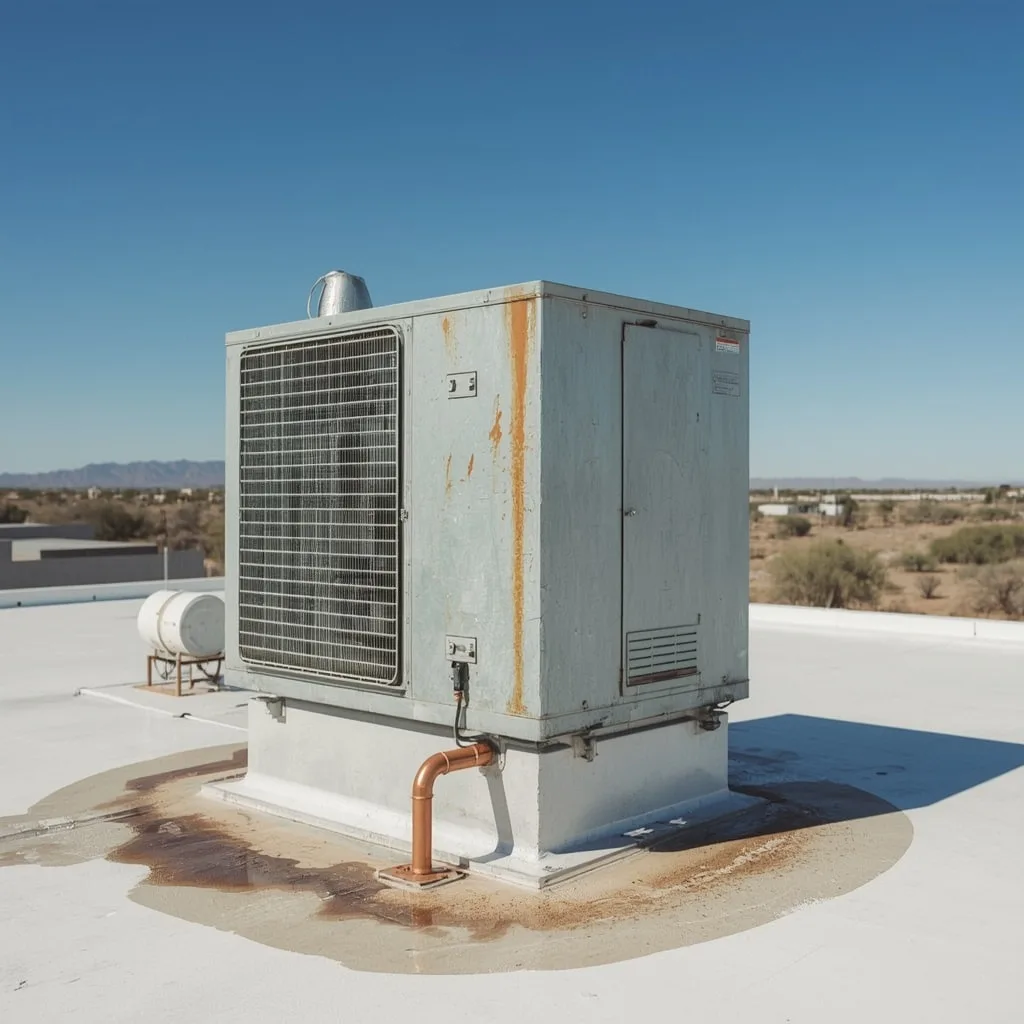
The unit on the roof,
and the line that drains it
Cooling equipment in {{MAIN_AREA}} sits above the ceiling rather than beside the house, which means everything it leaks drains into the building instead of onto the ground.
A machine on the roof is fed water, and it sits over the one part of the house nobody walks through. That is the whole reason these losses are found late.
Why position decides
the damage
In most of the country the cooling equipment sits on a pad beside the house and the furnace sits in a basement. Water escaping either goes onto ground or onto a concrete floor with a drain in it, and somebody notices a puddle.
Here the same failure happens above the ceiling. Rooftop package units, evaporative coolers and attic mounted air handlers all sit at the top of the building, so gravity works for the leak rather than against it. Water leaves the unit, crosses the roof deck or attic floor, follows a truss or a duct, and appears at a ceiling some distance from where it started. There is no puddle to see, because the attic absorbs it first.
The float switch
A float switch fitted to the pan or the line shuts the system down when water rises, which converts a ceiling collapse into a hot afternoon and a service call. Whether your unit has one is worth knowing before July.
Evaporative coolers, and
the five things that fail
An evaporative cooler runs water over pads and pulls outside air through them. It is connected to a water supply, deliberately, for the whole season, and everything about it is meant to be wet.
- 01
The float valve sticks
A float shuts the water off at a set level, and it is a mechanical part sitting in hard water. When it sticks open the reservoir overfills continuously, and the overflow goes wherever the roof allows.
- 02
The pads channel
Mineral builds on the pads and water stops distributing evenly. It finds a preferred path, runs down that channel in volume, and misses the pan. The cooler also stops cooling properly, which is usually what gets noticed first.
- 03
The pan corrodes
The reservoir holds standing water with a rising mineral concentration in full sun for months. Metal pans rust from the inside and the failure point is usually a seam, so the leak is slow and continuous rather than sudden.
- 04
The bleed line blocks
A bleed line deliberately discards a small flow to stop the reservoir turning into concentrated mineral. It is small in diameter and blocks with scale, and when it does the mineral load climbs, which accelerates every other failure here.
- 05
It is shut down wet
In October the cooler stops being used and often nothing more is done. Water is left in the pan, the supply line stays charged, and the unit sits through winter wet. The following April somebody turns the water on and finds out what corroded.
Air conditioners, and
the two parts that matter
An air conditioner is not connected to a water supply, but it makes water. The cooling coil condenses moisture out of the air passing over it, and on a heavy day that is a real volume, produced continuously, which has to leave the building.
The condensate line
A small drain line takes water from the coil pan to somewhere outside. It fails here for a local reason: very fine dust gets into everything in this valley, particularly after outflow winds and haboobs, and once that dust is sitting in a wet line the algae growing in standing condensate bind it into a plug. The plug gives no warning. The line stops draining on the hottest week of the year, when the unit is producing the most water it will all season. Then the pan overflows, and what happens next depends on the second part.
The secondary pan
An air handler in an attic or a closet is supposed to sit in a secondary drain pan with its own drain line, to catch exactly this. Two things go wrong. The secondary line often terminates somewhere deliberately conspicuous, over a window or an eave, so that water dripping there is the alarm telling you the primary has blocked, and nobody knows that, so it gets ignored. Or the pan has no line connected to anything, has rusted through, or is full of the same dust, at which point it is not a safety device, it is a tray.
Why it is always found late
These leaks do not present at the source. They present at the first place water can escape the assembly: a ceiling edge where drywall meets a wall, the corner of a hall closet with the air handler in it, or a stain in a bedroom two rooms from the unit.
By then it has been running a while. Attic insulation absorbs a great deal before it passes any through, the framing takes on moisture, and ceiling drywall holds water until it is saturated enough to stain. A drip that started in June can present as a stain in July, and the material above the ceiling has by then been warm and wet for weeks. That is the ideal set of conditions for what the 48 hour window describes, arriving without anybody having had a window at all.
The other version of late is the house with nobody in it. A cooler that was not shut down properly, or a condensate line that blocked in August with the owners in another state, gets discovered in October by whoever opens the door. There is more in the house nobody is in.
This is where these losses become an insurance conversation rather than a repair conversation, and the outcome turns on how long it had been happening.
What to check, and when
- 01
In April, before the cooler goes on
Go up with somebody comfortable on a roof, or have a technician do it. Look at the pan for rust, pinholes and a soft seam. Check the float valve moves freely and shuts off. Replace the pads rather than washing last year’s. Clear the bleed line. Then charge the supply and watch it fill and shut off once before you walk away.
- 02
In April, before the air conditioning runs hard
Have the condensate line cleared as part of the service visit rather than assuming it was. Find where the primary and secondary lines terminate. Look in the secondary pan for standing water or rust and confirm its drain goes somewhere. Ask whether the unit has a float switch and whether it works.
- 03
Every month through the season
From the ground, look at the roof under the unit and the wall below it for staining. Indoors, look at the ceiling nearest the unit and the ceiling edge in the closest hallway, and put a hand on the floor of the closet with the air handler in it. If water starts dripping from the secondary termination outside, that is not a nuisance, it is the alarm going off.
- 04
Watch the weeks after a dust storm
Outflow winds drive very fine dust into everything, including through attic vents and into the air handler. Those are the weeks when condensate lines block and filters load up. See what the dust gets into.
- 05
At shutdown in the autumn
Shut off the water supply to the cooler at the valve, not just at the switch. Drain the reservoir completely and dry it out. Disconnect and drain the supply line, and cover the unit. A cooler left charged and wet through the cool months is the one that fails in the first week of use next year.
How the claim gets read
| What happened | How it is usually read |
|---|---|
| A sudden failure | A float valve that let go, a pan that split, a line that blocked and overflowed within days. Sudden and accidental water damage is generally covered, and the damage it caused is the claim. |
| A season of dripping | A cooler that has been overflowing on and off since May, or a line backing up intermittently, is usually characterised as long term seepage, and long term seepage is generally excluded. |
| The equipment itself | The failed component is normally treated as maintenance whichever way the rest goes. Policies respond to what the water damaged, not to the part that broke. |
| What the record decides | Dated photographs, service receipts showing the unit was maintained, and a clear account of when the stain first appeared separate the first line from the second. Report it the day you see it. |
Read next
-
01
The 48 hour window
What has to be dry, how quickly, and why a warm attic is the worst place to be slow.
-
02
What the dust gets into
Haboobs, fine dust, and the HVAC systems it ends up inside.
-
03
The house nobody is in
Closed houses, a valley summer, and losses nobody sees until autumn.
-
04
Questions and answers
Twenty questions about claims, drying, mold and what any of it depends on.
If a ceiling has started
staining under a rooftop unit,
it has been wet
longer than it looks.
Emergency service across the valley, dispatched 24 hours a day. Independently owned and operated.