
Monsoon season
June 15 to September 30, and the ways a storm that lasts forty minutes puts water inside a building in {{MAIN_AREA}}.
Dispatched 24 hours a day across the valley.
What the monsoon
actually is
The North American Monsoon is a seasonal shift in wind direction. For most of the year the air over Arizona arrives dry from the west. Through the summer the flow turns and brings moisture up from the south, and that moisture, with intense surface heating, produces thunderstorms across the state. The National Weather Service fixes the season to calendar dates, June 15 to September 30, so everyone counts it the same way.
It is not a rainy season in the sense the phrase carries elsewhere. There are days of nothing, and then a storm that develops in an hour, does everything it is going to do in forty minutes, and leaves.
- 01
Season opens
June 15, so that everyone counts it the same way.
- 02
Season closes
September 30 on paper. The last real storm can be earlier or later.
- 03
One storm
Develops in an hour, does everything it is going to do in forty minutes, and leaves.
Almost everything the season does to a house is decided before it starts, by where the water goes when the ground refuses it, and by whether the roof is ready for a wind that arrives without building.
Three things arrive,
in this order
- 01
Outflow wind
A collapsing thunderstorm pushes cold air down and outward along the ground at 40 to 60 miles an hour, arriving as a wind shift rather than a gust that builds. This is what lifts roof tiles out of course.
- 02
Dust ahead of the rain
The outflow crosses open desert first, so the dust arrives before the rain: into attic vents, past window frames, through the weep screed, and into the return side of the air conditioning.
- 03
Short, very intense rain
Dry desert soil sheds water, and caliche hardpan under much of the valley infiltrates almost nothing, so most of what falls becomes surface flow within minutes and starts looking for the lowest door.
The shape of the season,
month by month
The second half of June is usually the driest part of it. The calendar season has opened but the moisture often has not arrived, and the first activity is wind and dust with rain that evaporates before it reaches the ground.
July is when it becomes a season. Storms turn regular, the first significant outflow events move roof tiles, and the ground is still fully dry, so early rain runs off almost entirely. Roof damage from July often does not show inside until later, because it takes a second storm to drive water through the gap the first one opened.
August carries the heaviest part of it. Storms come more often, the ground gives back more of what falls as runoff, and this is when washes run, streets flow, and houses on the fans take on sheet flow across the yard.
September tapers unevenly. Late season storms can be broader and slower moving, and moisture from decaying tropical systems in the eastern Pacific sometimes reaches the state, producing longer rain on loaded ground. The season closes on September 30 on paper. The last real storm can be earlier or later.

- 01
Late June
Wind and dust, with rain that evaporates before it reaches the ground.
- 02
July
Storms turn regular, the first outflow events move roof tiles, and dry ground sheds almost all of the rain.
- 03
August
The heaviest part of it. Washes run, streets flow, and houses on the fans take sheet flow across the yard.
- 04
September
Broader, slower storms on ground that is already loaded, tapering unevenly toward the end of the month.
The four monsoon pages
-
01
Why desert homes take on water in August
Why ground that has been dry for months is worse at absorbing rain, and how surface flow finds a garage threshold.
-
02
Why a house nowhere near water takes on water
Shallow unconfined water crossing a broad apron on the western edge of the valley, what FEMA Zone AO describes, and what the flood policy does.
-
03
What happens when the tiles move
Outflow wind against a concrete tile roof, and why the layer that keeps water out is not the layer you can see.
-
04
What the dust gets into
Where fine mineral dust enters a closed house, what it does to an air handler, and what the rain an hour later turns it into.
What to do in May
Six things, in order, and all of them are easier in dry weather.
None of it needs equipment, and the last one is a telephone call rather than a job on the property. All of it is easier before a storm is in the forecast than after one.
- 01
Walk the lot and work out where water will go
Where does water enter the lot, where does it leave, and what is in between: a gate that dams, a raised planter, gravel that has reversed a slope, a neighbour’s new wall. The lowest opening in the building is the one that matters, usually the garage.
- 02
Clear the weep screed
The slotted strip at the bottom of a stucco wall lets water out of the assembly. Landscaping and soil piled against it stop that, and the wall holds water instead. It needs clear air below it.
- 03
Check the seal at the garage threshold
The bead along the bottom of the door is the difference between an inch of water in the street and an inch of water on the garage floor. Look along it with the door shut and see where daylight comes through.
- 04
Clear the scuppers and roof drains
Flat and low slope roofs drain through a few openings, and one storm delivers more water in twenty minutes than they usually see in a year. A blocked scupper turns a roof into a pond over the ceiling. Clear the overflows above them too.
- 05
Photograph the property in dry weather
Every elevation, the roof from the ground, the yard, and the interior room by room. Photographs taken before the season establish the condition a claim is measured against. Keep them somewhere other than the phone in your pocket.
- 06
Find out now what the policy does about surface water
A standard homeowners policy excludes surface water. Water arriving across the ground, off the street or as sheet flow is flood, and flood is a separate policy through the National Flood Insurance Program with a thirty day waiting period. Buying it in July does not cover you in July. Roughly a quarter of paid flood claims are outside high risk zones, so low risk is not the same as no exposure.
If a storm has
already done something
The first question is always where the water came from, not how much of it there is. Wind damage to a roof, and the water that follows it inside, is generally covered. Water that crossed the ground to reach the building generally is not. The sequence for anything actively wet is on the first hour after a leak, the clock that starts when a building gets wet is on the 48 hour window, and the rest is at what happens to buildings here.
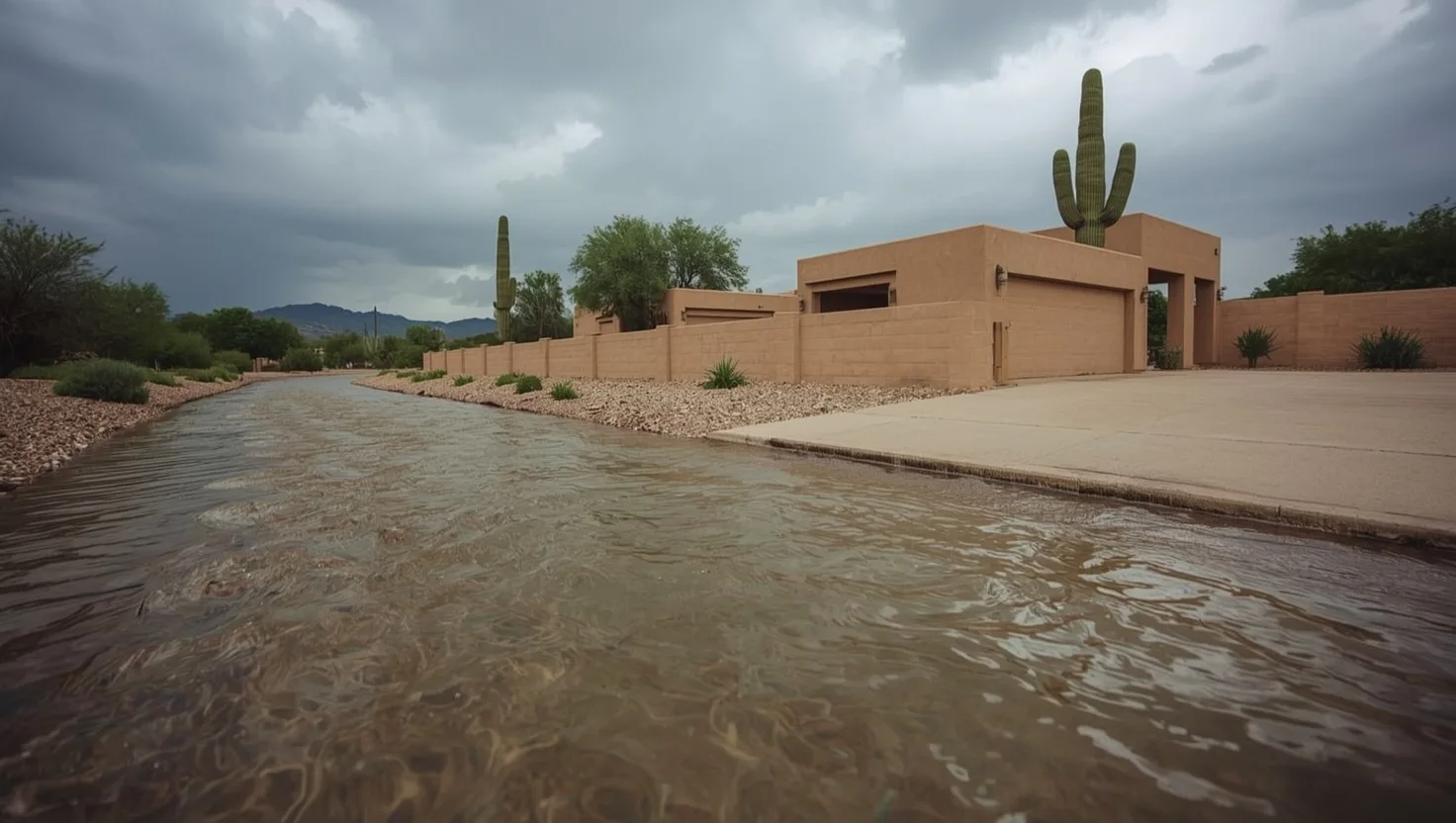
Never drive into a flooded wash or past a barricade. Moving water hides how deep the crossing is and how much of the road is still there, and Arizona has a law on the books, commonly called the Stupid Motorist Law, because people do it anyway.
If a storm has put water into a building, the useful call is short and it does not need to wait for morning.
Emergency service across the valley
Dispatched 24 hours a day
Independently owned and operated